Saturday, November 27, 2010

Thanksgiving Whitewater Hike

Tis the season! The boys are coming home for the holidays, and we are hiking. Also, it is the season for the Christmas Bird Counts! This year I have the holidays off, and I have a good chance of attending most if not all of the CBC's in my area. I am looking forward to this, and will be posting these adventures as they occur.

This year has been an interesting year for birding as we have seen several rare birds in the Morongo area, including a Dickcissel, and an Ovenbird, (I didn't actually see this bird, but heard a lot about it). So it is possible we will see more new and different birds during the CBC's. One of the trips I hope to make will be to the San Jacinto Wildlife Refuge, and I hope to see a Bald Eagle, and my nemesis bird, a Golden Eagle.

As exciting as the prospects are, it is always exciting and fun to have the boys come home, no matter what the reason. The holidays provide a terrific excuse and reason to get together. We eat, catch up on each others' lives, and hike. I think I have said before that when we go hiking, we never keep track of the miles, we go to see what is there. So, we will take off and soon my oldest son will detour and make some exclamation about a plant he has seen, step off the trail and rub a leaf, or snap off a flower and explain what the plant is known for, or can be made into. We spend some time looking at the plants nearby and discussing what Native peoples used the plant for, and the type of ground it grows in and more. Then we strike off again, and soon we see a bird or flock of birds and we are distracted again until the birds leave us. Then we will see animal tracks or some geological formation that we have to ask Nancy about if she has accompanied as we forget the geological terms. So, many of our hikes may not be very many miles long, but we have been out there for hours.

So, it was that Taylor and I decided to go to Whitewater for our Thanksgiving holiday hike. Austin had to work and Harrison decided to spend time with his girlfriend and other friends by going to lunch with them, (go figure!). Andi stayed home and took a walk of her own.

We chose Whitewater because we hadn't been there in a while, and it was close, which fit in the time frame we had. I have to tell you that I went with some reservations, as I remember being disappointed the last couple times I went there. The conservancy had made some terrific modifications and made great strides in improving the place, but there was relatively few birds and wildlife. We saw a few here and there, but nothing to get very excited about. So, I went with the idea that it would be nice to hike with my son. I took my camera and binoculars almost out of habit.

Boy was I wrong! We got there and Taylor, who puts together training and nature centers with walks and education centers and more, was excited from the get go about how many cars were in the parking lot. There were people milling about the ponds, picnic tables, and in the visitor center. This was good.


We parked and started off. We started on the well marked trail by the north pond, and Taylor immediately stopped and took photos on his phone of the pond, the markings of the trail, and the large rock they used as a signpost with names and mileage listed along the length of the boulder. Listed on the boulder were .5 miles to the Pacific Coast Trail which runs through the Whitewater area, and Anchorage, Alaska, and Mexico. There was an information board next to this as well, with information on the wildlife in the area, and that the area was the intrusion of the southern tip of the Chaparral area in California, very different from the Desert just a couple miles down the road.


For the uninitiated, Whitewater used to be a fish hatchery, and we used to take the boys there so they could fish for trout. It was a pleasant place then with a series of ponds and a fish ladder and more. It sits at the mouth of a very large valley that looks as if it has been a large river in times past. There is still water running down the large washday, but most of it is rock and sand surrounded on the sides by large hills of beautiful geology, showing many colors and formations that are different from the desert formations in the Coachella Valley where we live. You can see for miles. You can hike for miles as well, as it goes and goes and goes.


My impressions were that the place had really grown up. The small bushes and dead trees were now full grown thickets and the dead trees were surrounded by Laurel Sumac and shoots of younger trees and more. There was a goodly amount of water in the area. Water was running in a good sized stream, as well as smaller creeks branching off and flowing down through the rocks and sand of the river bed, and small ponds at various locations. For those of us from the desert, this was a lot of water. As a result there was a good amount of Typha, and Scirpus plants, (Taylor pointed these out to me, I saw Cattails).


We strolled along the well marked trail as Taylor pointed out certain plants and explained what to expect from their blossoms, and what their roots would do and more. He pointed out the "taco plant" or Laurel Sumac, that has leaves that fold up, giving the impression of a taco shell. The growth was head high and thick in parts, especially along the water ways.

It was a beautiful day and cool. There was gurgling water, whispering cattails and other bushes, bright sunshine, absolutely brilliant blue skies, and the calls of birds and ground squirrels. We found a canine footprint in the mud, and Taylor explained that you can tell the difference between canine and feline tracks by making an 'X' through the print. If you can mark an 'X' without touching the pad of the print, it is a canine print. Usually there are nail or claw impressions, (as we saw), as well.

As we strolled along we met other hikers, and one couple were walking while holding Starbuck's cups. Taylor sounded incredulous as he asked them, "Is there a coffee place up there?" indicating farther up the trail. They laughed and the man said there was, while the woman said no there wasn't, but it was a nice walk. We met with a group of three who asked if we were looking for birds, (I guess the bins and camera were clues), and when we said we were, told us of birds they had seen and where. So we left there looking for a California Thrasher, California Towhee, and Scrub Jays.


We turned the corner and while hearing the call of small frogs from the nearby pond, we saw a California Thrasher, (Toxostoma redivivum) dive into the thick brush along the hillside. We walked on and saw a pair of Western Scrub Jays, (Aphelocoma californica), working the wash. Ravens floated with a flock of what I believe were White Throated Swifts, (Aeronautes saxatalis).
We saw movement in the brush and saw a couple California Towhees, (Pipilo crissalis), then a Spotted Towhee, (Pipilo maculates) flashed past us. We heard and saw Bewick's Wrens, (Thryomanes bewickii) as we stepped over the small bridges over waterways.

At one point we decided to cross over the river bed, and walk back toward the visitor center/picnic ground on the other side where there is a fire road along the opposite hillside. As we crossed we saw a paw print in the sand that looked different. Using the 'X' theory, we saw that it was indeed feline, and it was large. So, by deduction we believe it was a mountain lion track and not the smaller bobcat. I know it doesn't make logical sense, but I really did look up and further around for the mountain lion. That is like seeing the deer crossing signs on the roadway and begin looking for deer. I didn't see the lion either.


As we wandered down the fire road, we saw a good sized flock of Bushtits, (Psaltriparus minims), moving from bush to bush and chipping to each other as they moved along the hillside. As we got closer to the visitor center we saw flocks of White Crowned Sparrows, (Zonotrichia leucophrys), and a Lincoln Sparrow, (Melospiza lincolnii) or two. As we approached an ancient stand of trees, Taylor remarked we should see some sort of woodpecker, like a Flicker or two, as he pointed out a hole or two that had been excavated in the trunks or large branches of the trees. Like it was waiting to be called, a red shafted Northern Flicker, (Colaptes auratus) landed on the branch of the tree. While we were admiring this bird, we heard the calls of quail nearby. Soon we saw them scurrying from one brushy hideout to another, then across the road. Unfortunately, I was unable to properly identify them, but believe them to have been Gambel's Quail, (Callipepla gambelii). I have heard there were California Quail in the area, but I didn't get a good enough look to make the determination. The one I saw the best was a female and from what I saw and what I read in the Sibley's, I think we watched and heard Gambel's.


We saw a Phainopepla, (Phainopepla intense), in the dead and dry brush along the pathway. Also, as we walked, talking, looking and listening to the surroundings, Taylor pointed up the canyon and we saw a Cessna airplane sailing very low down the rocky riverbed. I was able to snap a photo as the plane climbed up a little and exited the canyon.


Altogether, a pleasant hike on a gorgeous day, with a lot of wildlife in the area. I was pleasantly impressed with the improvements and the numbers of birds in the area, as well as the signs we saw of other wildlife. I will return here.

As a side story, Taylor and I went to a small art show at Frances Stevens Park in Downtown Palm Springs today, Saturday, and found a terrific wildlife painter. Taylor found me gaping at some other terrific art and told me to follow him because he was going to blow my mind. He did. The pictures were simple, but terrific. She works in watercolor, but the detail in her paintings if phenomenal. Her name was Penelope Krebs, and she lives in Morongo, near the Morongo Preserve. Her website is www.penelopekrebs.com if you want to see some of her work. Taylor bought some of her prints, and I got a business card which is a work of art in itself, a pair of Gambel's Quail with her name underneath. Another pleasant surprise of the weekend.

So, you might be a birdnerd if...you look hike for hours but have no idea how far you have trailed. You can give a detailed list of the birds and wildlife you saw, however.

Sunday, October 10, 2010

Big Morongo Preserve

Saturday, 10/9/10, was a perfect example of a retirement day in our household. When I tell people that I am really enjoying retirement, this is the reason why. There are things we need to do to make it perfect, like making enough to pay for our school loans so that Andi can retire with me, but this is the prize we are working for.

It is Saturday morning at about 8:00AM, and I am parking my Honda Insight in the parking lot of the Big Morongo Preserve. Dee Zeller waves greeting as I step out of the car. There are others milling about the parking lot that I don't recognize, but I knew we were all there for the same reason, birds.

My dad told me years ago that everyone wears a uniform. If I were to ask you to visualize a cop or fire fighter, you would most readily think of their respective uniforms. If I ask you to visualize a gang member there may be some differences but most could come up with a particular set of clothing, grooming or lack thereof, and even stances or behaviors.

It is the same with birders. Who else would be in a wooded area as the sun begins to bathe the area in warmth and brilliant light. Who else packs bottles of water, cameras, and most importantly, binoculars on their bodies while wearing sensible shoes. Who else is already looking up in the trees for something flitting about. Who else carries a three pound book in a pocket or shoulder pouch that will help them identify what they see this day. Yes, they were birders. Thus started my day.

Today was no ordinary birding day, (is there one?). Today, we would be led on a birdwalk by Dee Zeller, camp host for the Big Morongo Preserve, (www.bigmorongo.org), then we were to be entertained with a lecture by Chet McGaugh. Chet is an ornithologist who has birded this area for nearly 33 years and has seen many changes in the area as well as the numbers and kinds of birds found here. He works with and has been deeply involved in the San Bernardino Museum and Audubon Society, leading the way on several projects of various sizes over the years. Chet and his lovely wife drove out from their home in Riverside to meet with our group and show us a short history of birding in the Preserve, which he broke down into the various seasons. It was enlightening to see which kinds of birds we could expect at each time of year.

But I have gotten ahead of myself. We started out with a short gathering in the parking lot, and a total of around 40 people of all ages, sizes and shapes gathered to hear the organizer of the event, Seth representing Joshua Tree National Park, give a brief introduction of Dee and what we were to expect. There were several regulars, like Margaret who is very knowledgeable and regularly keeps records of how many and what kinds of birds we see on these walks, today was no exception.

Also there was Bill with his camera and large lens, (envy, envy, envy), ready to document our journey today. Also, Dan, the new dad, was there with his ever-present scope. It turned out this was fortuitous, as without the scope, several of the hikers would not have seen some exciting birds.

Then there were new faces, including a young family with four young girls dressed properly for a hike. There were young women armed with pen and paper to document what we saw during our event. I believe this was a school assignment or perhaps extra credit. There was young couple, and several older couples. These were an odd assortment of people that may not have hung out together, except for their shared interest in birding this morning. How wonderful!

Dee had us start off and between he and Margaret they shared information on the types of plants, some of which were used as food sources by the Native Americans in the area, the birds we saw and the geography and habitats we could see along our hike.

Before we completely left the parking lot, but at the head of a trail, Dan called out that we were seeing something unusual near the more normal California Thrasher,(Toxostoma redivivum), White-Crowned Sparrows, (Zonotrichia leucophrys) and House Finches, (Carpodacus mexicanus). The bird teased us with short glimpses at first, testing the identification skills of Dan and Bill who were trying hard to pish (yeah, I know) the bird out into the open. It worked, the Dickcissel, (Spiza americana), hopped to the top of a small bush, and sat there for a good look at him for nearly 15 minutes. Bill got some photos, and Dan put him in the scope for all to see. Why was this exciting? Dickcissels are an East Coast bird, and we shouldn't see any west of Texas. Why was it here? Well, who knows? It was a young bird, probably first phase, (ornithologists use phases instead of years as birds mature at different rates, such as some gulls take two or three years to mature into the more recognizable plumage), and we had some strong storms recently, so perhaps it was migrating and was blown off course. We were just thrilled we could see him.

The Dickcissel was a first time sighting for many of us, and therefore a "lifer". It was also a first time sighting for Big Morongo Preserve as well. Already an excellent day. Dee commented he was a little disappointed, as he had planned for us to see this bird later in the walk, now his whole build up was for naught. That was his big finale and it came too early. We teased him, asking him if he tied the little bird to the bush, but he wouldn't make a commitment.

Never fear, we continued on and did find a couple other rarities, but nothing quite like the Dickcissel. We found a Red-naped Sapsucker (Sphyrapicus nuchalis), and were enlightened as to evidence they leave behind. They drill holes in the bark of Cottonwood trees and Eucalyptus trees, in a straight horizontal line, circling the trunk or branch in concentric circles. We were able to watch two of these guys at work during our walk. We also saw a Western Wood Pewee (Contopus sordidulus) flitting about the thick growth of the riparian habitat we walked through.

There were the usual Western Bluebirds, American Goldfinches(Carduelis tristis), and Yellow rumped warblers(Dendroica coronata). The Yellow rumped warblers were in good numbers and relatively new to the area. They come each year but they were not here earlier in the week. Yellow rumps are affectionately known as "Butter-Butts" in the birding world, and are pretty common at certain times of the year.

An exciting moment during our stroll was a Barn Owl (Tyto alba) flew across the open field for everyone to see. I tried really hard to look for the Ovenbird that (supposedly) has been seen in the area for the past two weeks, but to no avail. That would have been another "lifer" bird for me, but all I saw were warblers, finches, and jays. However, Margaret and I sat in the front yard of the Fishers, otherwise known as Fishers Point, (there is a sign), and we watched the birds enjoy the water feature built by the Fishers. As we watched the finches bathe and fly off, suddenly there was a brilliant yellow head sneaking around the feature. A Yellow Warbler (Dendroica petechia), was waiting its turn for a drink. It took a quick drink and flew. It disappeared, and we were discussing whether we really saw what we saw, when Bill came over and asked if we saw the Yellow Warbler. This was notable because they aren't supposed to be here for another month or two. A great day!

Then we sat in the little class room in Covington Park and listened to Chet discuss how Big Morongo Preserve is perfectly aligned at the edge of two large deserts, the Mojave and Colorado, and at the low end of the mountainous area, and the high point of the desert. It has a combination of riparian, wetland, open field, and desert habitats. All creatures represented in those climes and habitats are found at Big Morongo, including mountain lions, bobcats, tortoises, bighorn sheep, snakes and lizards, and, of course, various and sundry birds. Great place!

Chet showed us slides of birds he has seen at Big Morongo over the past several years. It was over all too soon at noon.

As we came out of the relative darkness of the room, we were met with several firetrucks and an Air Ambulance flying low overhead. There was a safety fair going on in the park and they landed the helicopter near the skatepark for all the waiting people to peruse. That was the end of birding and home I went.

That was a good enough day, but it was not over. I had tickets for a professional basketball game at Indian Wells. I, and my son, his friend, and our family friend Richard attended this outdoor basketball game between the Dallas Mavericks and the Phoenix Suns. The Suns won, and we had a terrific time, great seats and good food. We took another hike to get back to our car, but it was a pleasant night.

I think I am going to like this retirement thing!

You might be a birdnerd...if you get up early on a weekend day and go pishing with your friends in the woods.

Pishing is the sound one makes that is supposed to entice birds to come out to investigate what is making that infernal racket. One makes the sound by placing your tongue in the position to say shhh!, then add "p" in front of this. Thus, pish. I am not sure why this works, but it seemed to today with the Dickcissel. It is just, well, fun to do at any rate.

Monday, September 27, 2010

Big Morongo Preserve

We finally got to go out and see some birds again. I went about two weeks ago, with the intention of taking pictures for the blog, but when I got there I discovered the battery was dead on the camera. It was a nice walk anyway, but disappointing I couldn't take pictures.

So, it worked out better that Nancy, my long-time birding companion and former bicycle patrol partner downtown Palm Springs, called and said she needed a birdnerd fix. My son, Austin, is back from Jamaica where he spent some time in the Peace Corps, so he joined us.

We picked up Nancy at her home and drove up the hill to the high desert. This time I made sure the battery was charged and the lenses on my binos were clean. Once we got there and were properly nerdified, (hiking shorts, hiking boots, old baseball cap from the Long Beach jazz festival I attended with my oldest son, Taylor, binos on a harness over my shoulders, carrying a camera), we struck off on the trails.

On the way we kept seeing LBJ's, (Little Brown Jobbies, a term used by birders when they are not quite sure what just flitted by), and on the lower canyon trail watched a Prairie Falcon(Falco mexicanus) fly in a direct line up the canyon. I missed the shot of it, not even remembering I had the camera until it was too far gone. (So much for my career as a photographer!).

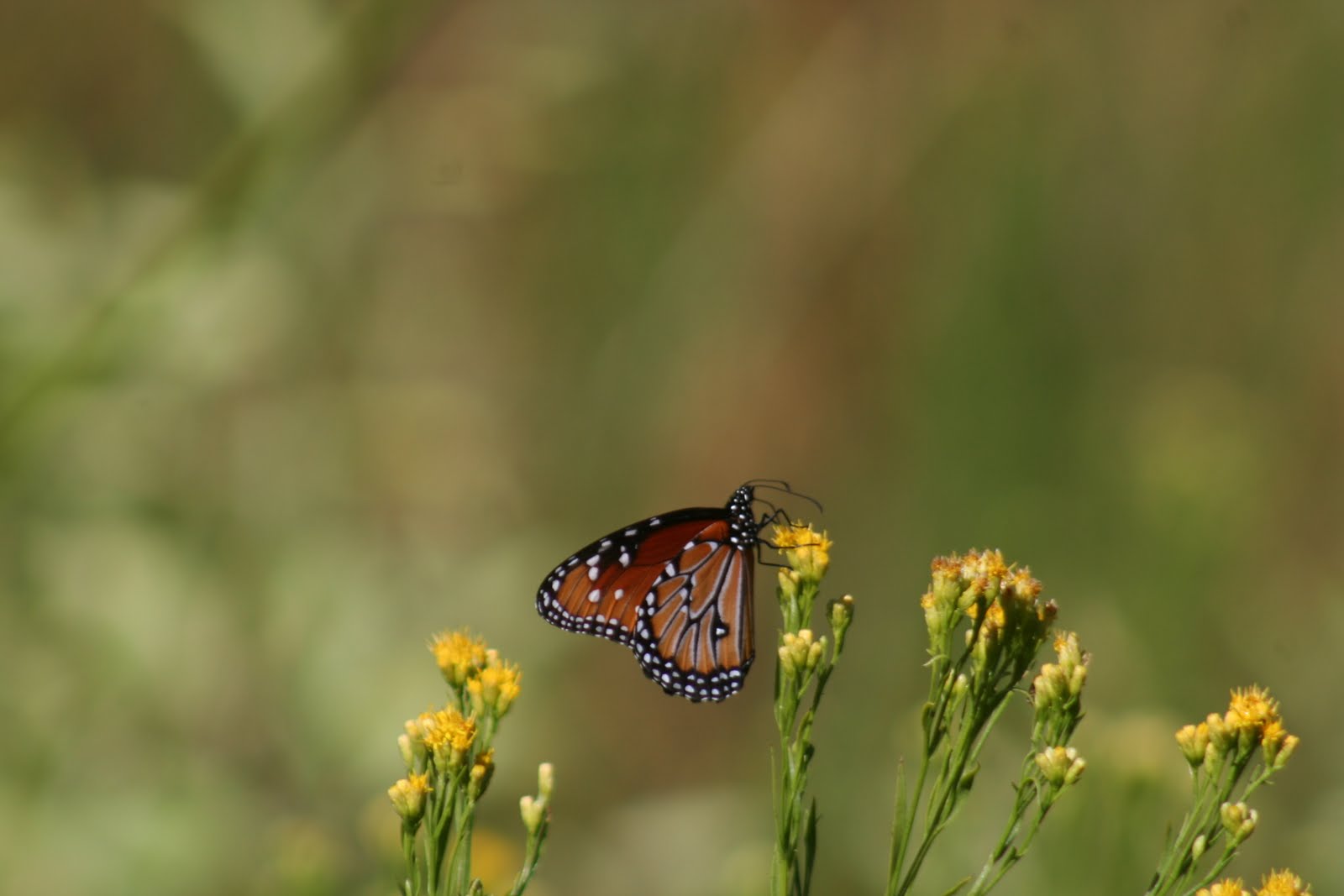
We continued our stroll with Nancy leading and regaling us with the current events from PSPD and her other adventures. We came to a small meadow and saw a beautiful butterfly. Not knowing anything about lepidoptery, I don't know which one this is, but it was pretty and it allowed me to take its photo.


We also saw a Black Throated Sparrow (Amphispiza bilineata) giving us a good look.

When we looped around and came back toward Covington Park, we soon saw several Western Bluebirds(Sialia mexicana), and then the signature bird of that area for me, the Vermilion Flycatcher (Pyrocephalus rubinus). It was in the area near the trees, which line one side of the tennis courts, that I have always seen it. It always keeps its distance, but goes about its business with little care for the number of people staring at it through binoculars, as well as the oohs and aaahs from those same people. Once you see this brilliant bird you wonder how in the world you could not see it. Then as you watch it disappears for a few minutes and reappears in all its brilliance.


We stopped in the park near the trees and followed the Vermilion and Bluebirds antics for a while, then Nancy jumped like she had been electrified, and pointed out into the field. I turned and saw the large blur of a Red Tailed Hawk leaping from the ground and heading toward a stand of trees. The Red Tail, (Buteo jamaicensis), is common, but impressive all the same. It is a good sized bird and a raptor, meaning it hunts and eats live creatures like squirrels, gophers, rabbits, even snakes. Nancy happened to have seen it dive down to the ground in an attempt to capture lunch, but it missed. The bird flew into the stand of trees and landed on a branch in the shade and all but disappeared. I ventured as close as I felt I could without disturbing it, (to be honest a barb-wire fence helped make the decision), and snapped a couple photos.


We finished our walk and found ourselves at the Dee and Betty Zeller home. They are the caretakers of the Big Morongo Preserve, and live in a trailer on the grounds. They have several feeders set up with a couple water features and chairs for better close up viewing of birds that dare to come near. Dee and Betty soon joined us and we caught up with some of the features of their lives, (their son is a chef, and will be soon opening a barbecue restaurant near the preserve), while calling out the kinds of birds we were watching. While sitting there we watched a Nuttal's Woodpecker (Picoides nuttalii) feed off the suet feeder, while a Lincoln's Sparrow (Melospiza lincolnii) drank from the dripping water feature. A Ruby Crowned Kinglet (Regulus calendula) flitted about the bushes nearby.


The most interesting event of the day was the spotting of two hawks that circled ever upward and farther away. They were a good sized bird, smaller than a Red Tail, but appeared to be larger than a Cooper's Hawk. The wings were broad and thick, with a short tail and relatively broad body. I couldn't get a picture as the bird and the camera were not cooperating. However, from every thing we saw and from pooring over the field guides, I feel rather confident in calling them a pair of Northern Goshawks (Accipiter gentilis). This is something rarely seen in this area, but otherwise a rather common bird. The markings we saw were different than the Red Shouldered Hawk I originally thought it was as there was no red color on the breast and wings like the Red Shouldered, but there were busy stripings on the wings and streaking on the body, as well as a buff or white rump. While I am uncomfortable with making these kinds of claims without a more qualified person, or photograph as evidence, I am about 80% sure that is what these were. Fun stuff!

Dee told us about an Ovenbird they saw the day before on their walk, and where we were likely to find it, but when we went there, we didn't see it. So, my plan is to return with the group, and Austin, on this Wednesday in the hopes of finding it.

So, You might be a birdnerd if... you plan a vacation or an outting particularly to see a specific bird.

Nancy and I went one August, (yes, the hottest month of the year), to see Wood Storks (Mycteria americana). Now, as a defense, Wood Storks are not in our area except for the summer. So, we loaded up in Nancy's Honda Civic, and drove to the Salton Sea to try to find a very ugly bird in high triple digit heat. We drove down to Sonny Bono NWF and spoke to a ranger there, asking about the storks. They were very helpful in telling us where others, (see insanity is contagious), had seen them the day before. With a rough idea as to where we were looking and a fresh water, we took off. We drove Nancy's tiny car on farm roads of dirt and rock for over an hour and found a small irrigation pond attached to a long ditch. There in all its glory, stood a Wood Stork, wading amongst several other types of birds that I can't even remember. I will always remember the Wood Stork though, and break into a sweat just thinking about it.

Sunday, August 1, 2010

New computer

It has been a week or so, and I have been lax in blogging. This is partly because we got ourselves a new computer. We have an Apple iMac with a movie screen sized monitor and all kinds of bells and whistles. Hopefully, it will make my blog look better as well.
This is my maiden voyage with the new computer and putting together a blog with pictures. So far it hasn't helped my spelling, but it is really fast.

While I was trying to think of what to put into the blog, I was reminded of a time that my friend Nancy and I took a walk up Mount San Jacinto from the top of the Tram. Especially at this time of year it is such a nice hike. The weather is a good 30 degrees cooler, but still bright and sunny. You literally go from triple digit heat, (today is a cool 104), to low 80's or even the 70's. You go from hot sand under foot with an occasional cactus, to loamy dirt trails, in amongst the tall pine trees and that great Christmas smell. A nice retreat during the summer. Then we who live here can return to the desert floor and get into the pool, a nice day.

Well, Nancy and I ride the Tram to the top, then hike one of the popular trails around a large meadow, where we see Violet-Green Swallows, Blue Jays, and Crows. We are talking and looking, and just generally enjoying our time in the cool mountain air, when a small group of men find us and holding their map ahead of them, ask for directions. They have wandered farther than they had planned and were not sure of the trail they were on. Nancy and I try to be helpful and start to look at their map. It just so happened that a pair of Clark's Nutcrackers landed in a small gully nearby and I saw them. So, in mid-sentence I call out "Clark's Nutcrackers!" and rush off. Nancy takes just a second to explain, "We're birders..." and she is in hot pursuit. We put them in the binoculars and watch as they flash in and out of the scrub brush and fallen tree branches, then fly off. I look up to see four men staring blank faced.

Nancy helps them out and they quickly say their thanks, and wander off, with a couple glances our way. We saw them later near the top where you can look out over the entire valley and they pretended they didn't see us. Unfortunately, this isn't the first time this has happened to me, and probably won't be the last. But I am trying and getting better at controlling my outbursts.

For example, we are sitting with friends in the house the other day. They are nice people and the conversation was fun. However, outside I watch as an Oriole flashes past the back door, and my heart jumps. But, I didn't jump up and charge into the back yard like I wanted to. I sat and nodded and smiled, while I hoped the oriole would return when these people left. They are transient to our area, and we only see them a couple weeks at a time, so it is always fun to see them in their glory when they come to our hummingbird feeders or to fruit I put out for them. (They like oranges or grapefruits).

So, today while I was in the back yard starting up the barbecue, I heard a different bird call, and looked around. I saw my oriole sitting in my palm tree. I was able to see and photograph a Hooded Oriole, (Icterus cucullatus), as he sat long enough for me to start the barbecue, go inside and recover my camera, change lenses, then come out and take some photos. He was very cooperative. I will probably receive a bill later. :)
(This is my most cooperative oriole. He was visiting while I barbecued. Glad I didn't have chicken on the grill this day, could've been ugly.)


While barbecuing I saw three different species of doves at my feeders. So, while the camera was out, and I was waiting for the meat to cook, I took some photos to compare the three birds.
(These are two of the three species of dove that regularly come to visit our feeders. The one on the left is a Mourning Dove (Zenaida macroura), they are the birds that make that mournful call you probably hear outside. The one on the left is a White-winged Dove (Zenaida asiatica). Notice the very white feathers on the front of the wings and more red legs.)
(This shows the White-winged Dove with a Eurasian Collared-Dove (Streptopelia decaocto). Notice the lighter color of the Eurasian Collared-Dove, and the black half-ring around it's neck, or collar. I like the red eyes.)

So, You might be a bird nerd if you are talking to friends and... oh! look an oriole!

Friday, July 23, 2010

V-V

This is getting rediculous, isn't it. I understand why you think this, but if I haven't sold you on Vancouver yet, this one should do it. Either way, this will be the last blog on Vancouver, with maybe a couple of mentions in future blogs.

In this one I will put a few more pics and discuss one of our jaunts out of Vancouver.

We decided to follow the advice of several of our friends that said something like, "If you go there, you have to visit Whistler." They also mentioned, for my sake, there was a place on the way that was called Eagle's Run, where the Bald Eagles nested. I heard stories of "...hundreds of Eagles..." and this was where they nested and even there were Golden Eagles there. Now, the Golden Eagle is one bird I am not sure exists outside captivity. I may have seen one or two, but making an identification in a fraction of a second at 70mph or so is difficult at best. There was that time we were walking on an Audubon hike and the leader pointed to a dot in the sky and said it was a Golden Eagle, and it may have been, but even with binoculars it was a dot, so it could have been a circling plane for all I know. I keep hearing people telling me they have seen a Golden Eagle, but I haven't seen one to know it, yet.

I digress. So with great anticipation we speed off northward toward Whistler, looking forward to seeing the Eagle Run along the way. We admire the beautiful scenery along the way, and watch for signs until we found one. We turned off and drove where it said, and ended up in a residential area. We turned down a street that looked likely to get us there, and found a sign saying we were entering private property that was not the Eagle Run. So we turned around and found a place for breakfast instead. After breakfast, we drove around and found the better road and ultimately found the Eagle Run. We parked our car one a gravel parking area on one side of the roadway, walked across the road and up an embankment that was a levee for a river that picturesquely flowed this cute little town. There were benches and an informational board posted that described the mating and nesting rituals of the Bald Eagle. Apparently the nesting area was across the river in the stand of trees that was thick over there.

This was a pretty place with brightly colored flowers, little cafe's, and people walking, but no eagles.

Poor Andi took a seat on one of the "viewing" benches, and read her book while I traipsed around looking for the eagles. I walked until I saw another of the signs saying this was Indian land and I would enter at my own risk. I walked the other way so I could get good views of the trees from as many angles as I could, but no eagles. I looked back across the roadway where there were some small farms and open fields surrounded by large trees, thinking they were sitting in these trees sniggering at me, but no eagles.

(The river and stand of trees with the mountains in the background, where the eagles were supposed to be).

(Andi reading her book while I am searching for the lost eagles.)
We finally decided to go on to Whistler and come back the next day to see if our luck changed. It didn't. We had a great time in Whistler and the surrounding area, but when we stopped again, (this time on the first try), there were still no eagles.

(I couldn't resist, a Canadian Cop. He was at Whistler and posing for pictures with his dog. He is a member of the RCMP, and apparently this was his assignment for the weekend we were there)>

(When there isn't snow, the mountain found another way of getting people to play. They made a mountain bike run. They lifted the people and bikes up the mountain, then they bombed down the trails of every level down the mountain).

So, no pictures of nesting eagles. However, I did get a couple shots back at Stanley Park of a couple other birds that were fun for me. When we got back from Whistler I was able to hike around the Lost Lagoon in Stanley Park and found several cool birds and a racoon, turtles and squirrels. This was a wonderful place, with several "rest areas" that one could stop and sit and watch people and animals move about. It was very peaceful and teeming with life just yards from a teeming cement metropolis.

So, here are some pictures of the Lost Lagoon and the things I saw there. Enjoy.

(This guy let me get close enough for this photo. A Northwestern Crow, Corvus caurinus).

(The Lost Lagoon, no Peter Pan and the Lost Boys were not seen here).

(Remember this guy? Mute Swan, Cygnus olor).

(Turtle log rolling contest. It isn't very fast but the drama was intense!).

(Cedar Waxwing, Bombycilla cedorum. Look at the wing and see the little red area? It looks like little wax drops on the ends of the feathers, hence the name).

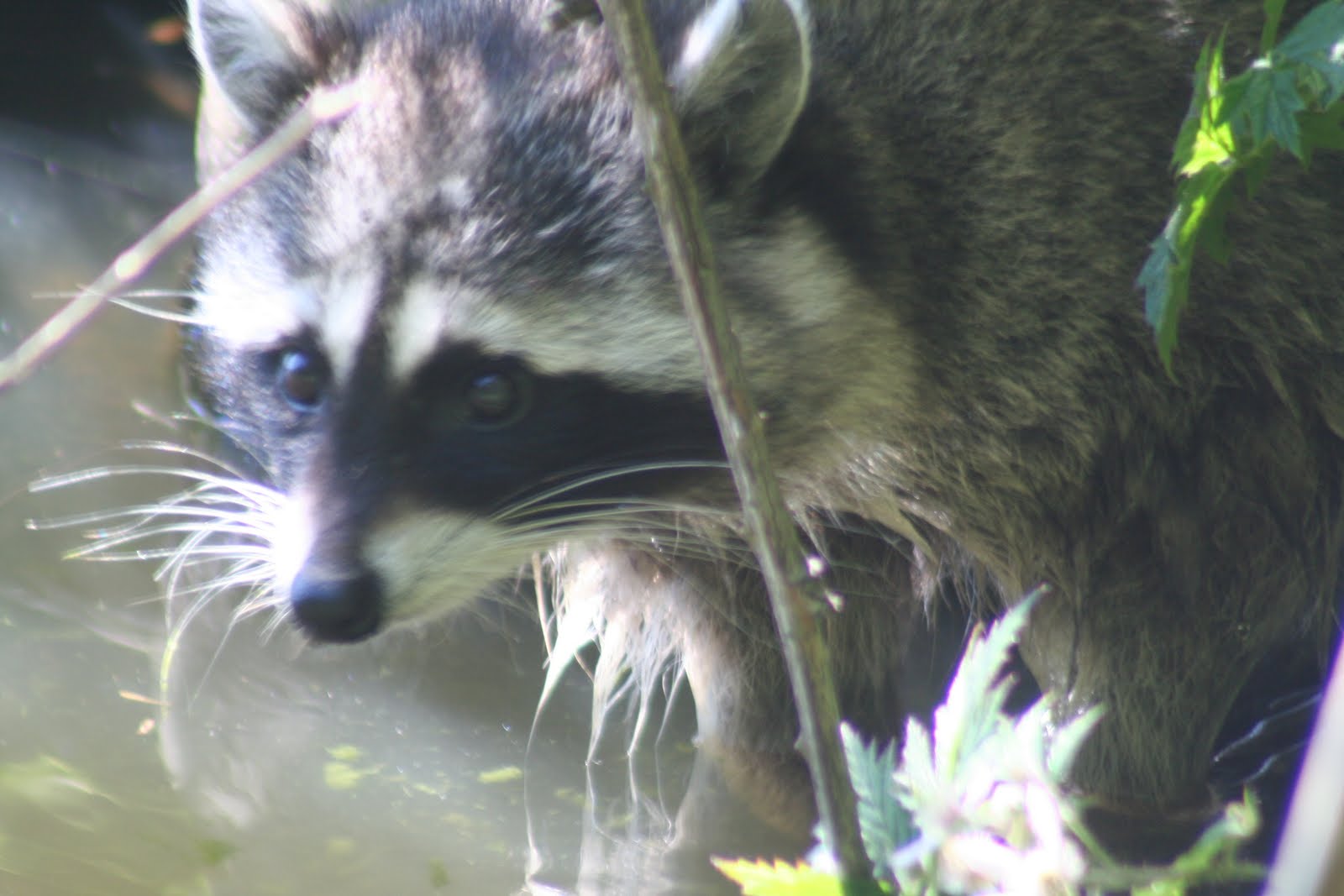
(Little racoon doing his thing in the water off the trail).

So, you might be a bird nerd if...you get terribly disappointed when something is named for a bird, and there are no birds!

Wednesday, July 21, 2010

V-IV

Andi did it again! She studied our maps and discovered another wildlife refuge called Swan Lake, (it is unclear if it was the one named in the ballet). It was a pretty cool little place.

We had to again drive through a residential neighborhood in order to find it, but we did find it. There was a little converted house that they used for the nature center, and the several acres around it were kept as wild as possible, while maintaining the trails and visibility for visitors. Inside the nature center we met this young lady that was very helpful and more than happy to show us all the exhibits they had inside. She showed us the bee-hive they had, with the queen marked with a red stripe, and told us about the hive history and activities.

She showed us the nest-cam they had with young Violet Green Swallows, (Tachycineta thalassina), about to fledge. We watched as mom would return to the nest, feed the young ones and fly away. One or two would creep to the edge of the nest and look around as if they were going to try to fly, and we would run to the window where we could see the nest box and see the little one's head poking out. Then they would back into the nest and wait for mom.

During our trip we saw Violet Green Swallows and Barn Swallows (Hirundo rustica) often. We also saw Northwestern Crows (Corvus corinus) everywhere from our condo to Whistler. I am making that i.d. as the book shows their range from northern Washington to southern Alaska along the coastline. The American Crow, (Corvus brachyrinchos), shows ranges inland from that and covering the rest of the country. These were definitely crows, and possibly somewhat smaller, otherwise, there was no difference between the two. By range alone I decided to make the i.d. and count it as a lifer for me.

Swan Lake was a beautiful little place, with a wooden dock for viewing, a floating bridge to cross the lake to another little wooded area, with viewing areas along the way. From the viewing dock we saw Common Yellowthroat (Geothlypis trichas), Mallard ducks with babies, but no swans. On the trail to the nature center we found a small Garter Snake.

(Common Yellowthroat talking to us as we walked out on the viewing deck).
Inside the nature center, the young lady told me of a nest or two the Marsh wrens (Cistothorus palustris)had built right next to the floating bridge. Andi gave her foot a rest while I braved the bridge.

(This is the Marsh Wren nest, look closely through the reeds to see the entrance hole)

(This is the little Marsh Wren making a spectacle of himself near a nest).

I found the nests pretty easily, seeing the little balls of weaved rushes swaying int the slight breeze at the top of the reeds next to the bridge. I also saw some pond turtles lined up on a nearly submerged log, as well as a mother Mallard with several babies lined up on their own log.

Across the bridge I found another nest, with the help of the Marsh Wren making quite a show of himself. He kept calling and flitting about gaining my attention that I began looking under him and found another little ball of weaved rushes. These little birds (about three and one-half to four inches long), are usually heard but difficult to see as they work their way into the reeds and stay there. This little guy was at the top of the reeds and singing loudly and often.

Just past this was a small backwater that had several napping Mallards in amongst the lily pads. I saw a couple at first, then as I continued to look, more appeared, like one of those Bev Doolittle paintings. (Luckily no wolves or bears came out of the scene).

(Momma Mallard and some babies resting on a nearly submerged log).

On the other side of the bridge the path opened into a small meadow surrounded by large trees with a Song Sparrow (Melospiza melodia)sitting in a small tree next to the path singing away. There was a Spotted Towhee or two,(Pipilo maculatus), and Red-Winged Blackbirds, (Agilaius phoeniceus).

At the front of the nature center we saw a tall pine that was topped off, and on the top was a Northern Flicker, (Colptes auratus). This is a type of woodpecker that is brown-gold instead of the usual black and white configurations of other woodpeckers.

This was another calm and beautiful location with lots of wildlife that I wouldn't mind returning to. Another good find by my wife. The nature center had used books for sale, souvenirs, and lots of good information about the surrounding areas. They had the bird cam, and the live bee-hive that was a kick to see. There were pictures of birds and other creatures that visited or lived at the lake, as well as live frogs, lizards, snakes and salamanders in cages to see.

You might be a birdnerd if...you get a kick out of a small nature center, and it is one of the highlights of your vacation, and you are an adult, not a pre-teen.

Monday, July 19, 2010

Vancouver III

Ok, Andi studied the maps and after we explored much of Vancouver proper, we rented a car and began to explore north of the city. We took a ferry across English Bay to Vancouver Island to see the cities of Nanaimo and Victoria. We had friends who gave us a list of things we had to see and do, and one of the things was the Nanaimo Bar. Imagine the disappointment on the face of poor Andi when we discovered that meant the desert, Nanaimo Bar, not the bar with drinks.

At Nanaimo, we saw a smaller ferry that would take us to the little island that populated with the rabbits with floppy ears, but it was too cold for us, and Andi's foot was still hurting and everything indicated there was a bit of walking to do once we got there. So, we found a nice place to eat and spent the night at the hotel. (This was the hotel we were staying in when we took the pictures of us smoking cigars and drinking wine).

Andi found a place on the map called Esquimalt Lagoon, (pronounced Es-kwy-malt), so we drove to it. There we found a spot on the one side of a bridge that gave us a view of the lagoon, but the bridge was closed to vehicular traffic and we had to go quite a ways around to find the other side, (which of course looked better).


That was alright, as when we drove through this residential district we were stunned to see a small herd of deer roaming the neighborhood. They were nonchalantly munching grass, scratching, and doing things that deer do, all in someone's front yard. I told Andi that was why none of the people there had lawnmowers, yet their lawns remained well manicured.
I (I didn't think they would let me get much closer than this so I snapped the shot, it shows the three of them together.)
(This is the Mute Swan posing nicely for us).
(This is the Trumpeter Swan giving us his best Clint Eastwood "Do you feel lucky..." look).

We moved past the deer and found the roadway to the other side of the lagoon, and Andi drove down to where I saw some Swans preening in the shallows near the road. She stopped and I hopped out with my camera and binoculars. I moved slowly and tried to get off the roadway and down the small embankment as quickly as possible without scaring the group away, then stealthily made my way toward the Swans, and Canada Geese milling about with them. It was kind of funny, because by the time I got down to the shoreline, it became very apparent the birds couldn't care less if I was there or not. They were busy preening and were not particularly concerned about my presence at all. They looked up from time to time, then blithely went back to doing their thing. So much for my skills.


They allowed me to get nice and close and I took a bunch of pictures of these large and beautiful birds. The day we were there, there were about five or six Swans. Three were in this group at this time, one Trumpeter Swan(Cygnus buccinator), and two Mute Swans, (Cygnus olor). Both "lifers" for me. As you can see from the photos, they are much larger than the Canada Geese, (Branta canadensis). This may give you an idea of their size, then you can extrapolate this to the size of an Andean Condor that my boys (Taylor and Austin) have seen in Patagonia. The Condor is the largest bird in the world with over a 12 foot wingspan and a body larger than even these swans. The boys said they saw several flying at a time each day they were in Patagonia. It must have looked like something pre-historic!

This was exciting enough for me, but as I got to explore the lagoon further, I saw over 20 Great Blue Herons, (Ardea herodias), Glaucous Gulls (Larus hyperboreus), many Mallard Ducks, (Anas platyrhyncos), Caspian Terns, (Sterna caspia), Barn Swallows, (Hirundo rustica), two Belted Kingfishers,(Ceryle alcyon), a couple Black Oystercatchers, (Haematopus bachmani), and of course, two Bald Eagles, (Haliaeetus leucocephalus).
(I just liked this view. I thought it would make a good painting.)
(At the top of these trees was a Bald Eagle calling to another that was soaring about the area.)
(This is the Black Oystercatcher. They use that chisel-like bill to open and eat mussels and other bivalves on the shoreline).
(As we were leaving we saw this pair of Mute Swans swimming with their babies across the lagoon.)

I had a great time there. There were shorebirds, waterbirds, sleeping birds, hunting birds, parenting birds, just birds everywhere. People came down to walk, walk their dogs, play with their kids on the rocky shore, have lunch or spend some quiet time in a beautiful setting. It was great!!

Oh, I also saw a small Garter Snake slithering through the grass on my way to the Swans.

Andi took advantage of the time and lovely setting to read one of her books, while I was snapping photos and talking to the birds, "Work with me baby, turn your head, get the glint of sunlight in your eye. That's it! Hold it!"

Tomorrow I will talk about Swan Lake and the little Nature Center we found there.

You might be a birdnerd if... you leave your significant other reading in the car on some lonely road, while you traipse around in the grass and mud trying to get a better picture of a bird.